How Much Does It Cost to Install a Soft Play Area?
A transparent, practical guide to budgeting for commercial indoor playground equipment. Covering every cost factor, safety standard, and decision point from initial brief to opening day.
The most common mistake operators make when budgeting for a soft play installation is treating it like buying a product off a shelf. Commercial indoor playground equipment isn’t priced like your living room furniture or gym equipment; the cost depends on a web of variables that no reputable playground manufacturer will be able to quote without understanding your venue, your visitors, and your goals first.
This guide exists because we believe transparency builds better projects.
As a design, manufacture, and installation business, we at The Play Company have delivered commercial soft play environments across leisure centres, holiday parks, family entertainment centres, holiday park groups and more. We’ve seen budgets of £25,000 and budgets of £600,000. Both produced excellent venues and spaces that have thrived from the play space, but only because the brief was right, not because the spend was high.
What follows is a genuine breakdown of what indoor soft play equipment costs in the UK, what drives those costs, what you absolutely cannot cut corners on, and how to evaluate the partner you choose to build it.
Soft play installation costs at a glance
The table below gives a realistic budget range by venue type. These figures reflect the full project cost of commercial indoor playground equipment — design, manufacture, and installation — but do not include premises fit-out, flooring, planning or building regulations work, or café/hospitality infrastructure.
Venue Type | Foor Area | Budget Rage | What’s Included |
|---|---|---|---|
Pub / restaurant add-on | 100–300m² | £20,000–£45,000 | Compact soft play structure, ball pit, toddler zone, basic theming |
Garden centre / farm park | 200–500m² | £35,000–£90,000 | Multi-level structure, themed elements, sensory zones, toddler separation |
Holiday park / resort | 300–700m² | £60,000–£180,000 | Full soft play environment, interactive elements, bespoke theming, multi-age zoning |
Leisure centre | 400–900m² | £80,000–£220,000 | Commercial-grade structure, GLL/operator specification compliance, integrated seating and safety surfacing |
Dedicated FEC / soft play centre | 500–1,500m² | £150,000–£400,000 | Full bespoke design, multi-zone environment, interactive play elements, theming throughout |
Flagship destination venue | 1,000m²+ | £300,000–£600,000+ | Bespoke design, interactive technology integration (Strike Arena, Valo Motion), full environment build |
The six factors that can affect your budget
No two soft play projects cost the same, because no two venues are the same. Understanding what drives cost means you can make smarter decisions about where to invest and where to hold back, as opposed to simply cutting the specification until it fits a number.
Floor area and venue footprint
The single biggest cost driver. Equipment cost broadly scales with floor area and the structural complexity of your space, such as ceiling height, columns, and access points.
These directly affect both design and installation cost.
Equipment type and specification
Traditional soft play structures cost less per square metre than interactive or technology-led equipment.
A venue combining both will have a higher upfront cost but typically delivers stronger ROI through longer dwell times and repeat visits.
Level of theming and bespoke design
Off-the-shelf modular systems are faster and cheaper to specify. Fully bespoke environments, however, with custom foam shapes, branded theming, and unique structures, will maximise your venue’s identity and commercial potential; however will require more design time and budget.
Age range catered for
Multi-age venues need distinct zones and areas. Toddler areas with appropriate fall heights and separate access, and an older children’s space with greater challenge.
Each zone has its own cost base, and safety requirements (EN1177) differ between them.
Safety surfacing specification
EN1177-compliant impact-absorbing surfacing is non-negotiable.
The required specification depends on the equipment fall height ( higher structures require deeper, more expensive surfacing ). This is not an area to economise on.
Installation complexity
Ground-floor single-level installs are the most cost-efficient. Multi-level structures, mezzanines, structural modifications, and interactive technology integration all add a cost ( and add value to visitors ).
We see that phased installation can help manage cash flow for larger projects.
"The best brief we ever received was from an operator who knew exactly who their visitor was, how long they wanted them to stay, and how much they needed to spend per head to make the numbers work. We could design around that. Budgets without context are just numbers."
Rob Christie, Commercial Director
Equipment types and what they cost
Indoor soft play equipment spans a wide spectrum, from basic foam and fabric structures to sophisticated interactive systems with digital scoring, motion sensors, and connected play. Understanding the categories helps you prioritise where your budget will have the most impact.
Traditional soft play structures
The core of most commercial indoor play areas is multi-level foam and fabric structures incorporating slides, tunnels, ball pits, climbing elements, and sensory features. These are manufactured in the UK to EN1176 standard, with costs typically ranging from £350 to £800 per square metre for a well-specified bespoke structure. The range reflects the theming complexity, structural height, and material quality.
Interactive and technology-led play equipment
Systems such as Strike Arena, Valo Motion, and Pixl Games represent a growing share of investment in commercial indoor playground equipment. Individual interactive units typically range from £15,000 to £80,000, depending on the technology complexity.
The commercial case for them is strong: they drive repeat visits, extend dwell time, and generate content that traditional soft play rarely produces.
Ninja and obstacle courses
Timed assault courses, ninja warrior-style rigs, and gladiator-format challenges are among the fastest-growing commercial indoor play categories we’ve seen in recent years.
A well-specified ninja course for a mid-size venue typically costs £60,000 – £120,000, depending on scale and the inclusion of integrated timing systems. They expand the addressable audience significantly so that older children and adult groups who would never enter a traditional soft play environment are natural customers.
Sensory and inclusive play zones
Sensory areas incorporating bubble tubes, fibre optics, tactile panels, and calming environments are increasingly expected in commercial venues serving broad family audiences.
Budget £8,000–£30,000 for a well-designed, dedicated sensory zone, which also demonstrates compliance with the Equality Act 2010’s reasonable adjustments duty for disabled visitors.
Inflatables and modular play
Inflatable parks and modular play systems offer faster installation and lower upfront cost, with scalable formats suitable for venues wanting flexibility. A commercial inflatable park typically runs £25,000–£100,000, depending on units and specification.
Not sure which equipment mix is right for your venue?
Our design team offers a free, no-obligation consultation to help you identify the equipment types that will deliver the best return for your specific venue and visitor profile.
Safety standards and compliance
Safety compliance is not optional, and it’s not a cost you can defer. Every commercial indoor playground equipment installation in the UK ( or anywhere else in the world ) must meet established standards, and as an operator, the legal responsibility for your visitors’ safety rests with you, not your manufacturer.
As standard, we adhere to all safety standards and compliance levels, giving you a handover pack breaking down what we’ve done.
Understanding the regulatory landscape before you invest protects you legally, operationally, and reputationally.
Standard Number | Meaning |
|---|---|
EN1176 |
The primary European standard for playground equipment safety. This covers design, manufacture, installation, inspection, and maintenance. Published in seven parts. All new commercial indoor playground equipment in the UK should be designed and installed to EN1176. The HSE provides guidance on EN1176 compliance via Entertainment Information Sheet 11. |
Compliance Note
Compliance with EN1176 does not remove the operator’s legal responsibility to maintain a safe environment and the courts have confirmed that compliance cannot be used as a complete defence in the event of a claim. The standard is a floor, not a ceiling. Regular inspection, documentation, and maintenance are what protect you.
Whilst we cover this during our process, you can also read more and understand more on compliance HERE.
Ongoing costs: maintenance and inspection
The cost of commercial indoor playground equipment doesn’t end at installation. Responsible operators budget for three tiers of ongoing inspection and maintenance, as recommended by RoSPA and the RPII.
Routine visual inspection (weekly or more frequently): Carried out by trained staff to identify obvious hazards, damage, or wear. Should be documented. Low cost but non-negotiable.
Operational inspection (monthly or quarterly): A more detailed, hands-on check of all equipment, fixings, surfacing, and ancillary items. Typically carried out by or with the support of your maintenance partner.
Annual independent inspection (RPII-qualified inspector): The most comprehensive check, covering full EN1176 and EN1177 compliance. Must be conducted by an inspector independent of the installing company. Budget £500–£2,000 depending on venue size and inspector.
Reactive maintenance and repairs: Foam replacement, fabric repairs, paint, and padding. Budget £2,000–£6,000 per year for a mid-size venue in normal operation, rising with age and usage intensity.
Interactive equipment servicing: Technology-led systems (Strike Arena, Valo Motion, interactive pitches) require annual software updates and periodic hardware servicing. Budget varies by system; The Play Company offers bundled maintenance packages.
Case studies: what real commercial installations look like
The range of what’s possible with commercial indoor playground equipment is best understood through real projects. The following case studies illustrate different venue types, budgets, and briefs — all delivered by The Play Company.
Planet Volt, Radstock
A purpose-built flagship family entertainment centre combining soft play, interactive play, ninja obstacle challenges, and Strike Arena across multiple zones.
One of the most ambitious commercial indoor play builds in the South West, designed to compete with major urban venues while serving a regional catchment.

GLL Liskeard, Cornwall
A commercial soft play installation for GLL (Greenwich Leisure Limited), one of the UK’s largest leisure operators. Delivered to GLL’s specification requirements with full EN1176 compliance, and multi-age zoning, all within a working leisure centre environment requiring careful installation phasing.
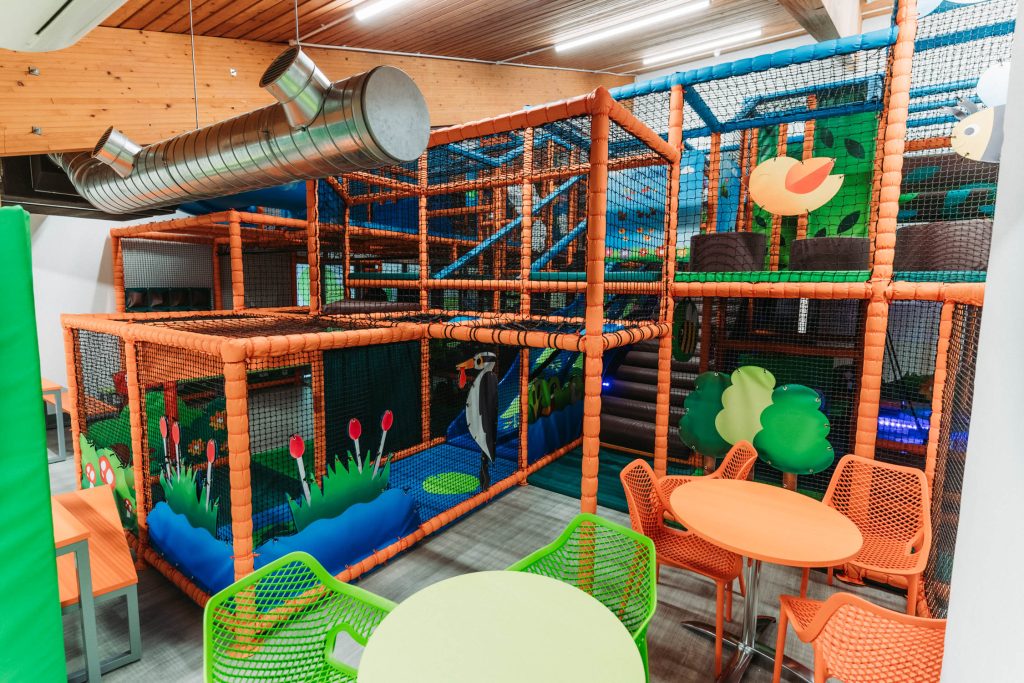
FreeDog, Swindon
Interactive play environment installed within an existing family entertainment centre. Demonstrating how technology-led play can be integrated into an established venue without a complete rebuild.
FreeDog’s Swindon site now operates interactive elements as it’s anchor attractions that drive dwell time and repeat visits across all age groups.
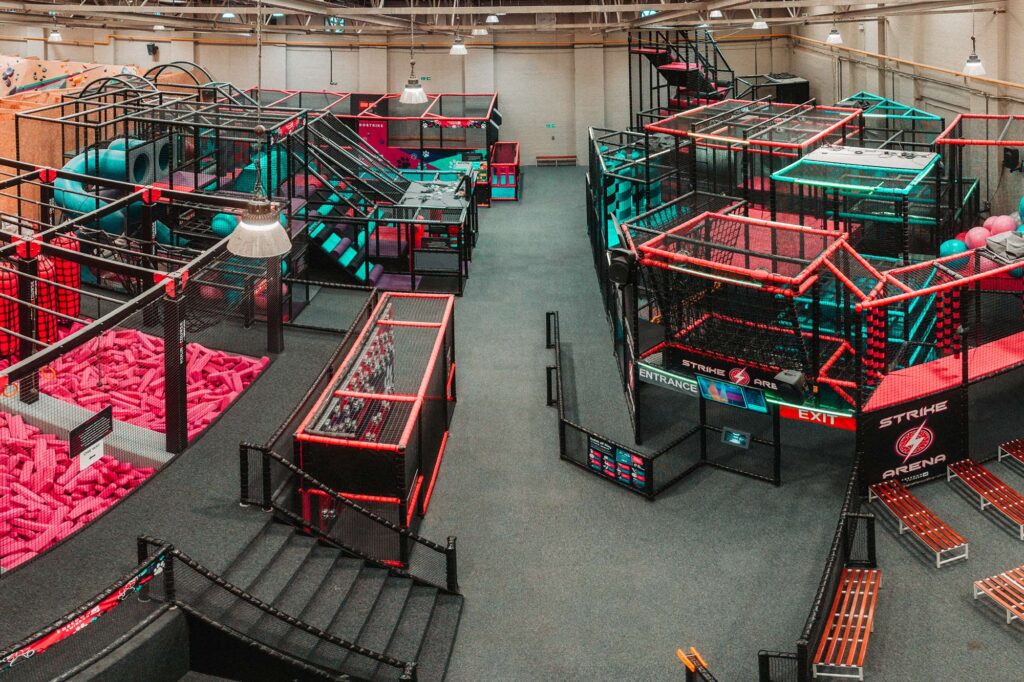
Swiss Cottage Leisure Centre, London
A high-footfall soft play installation within one of London’s busiest GLL-managed leisure centres.
The brief required commercial-grade durability, efficient cleaning access, and compliance with all EN1176 requirements, all within a tight install window in a central London site.
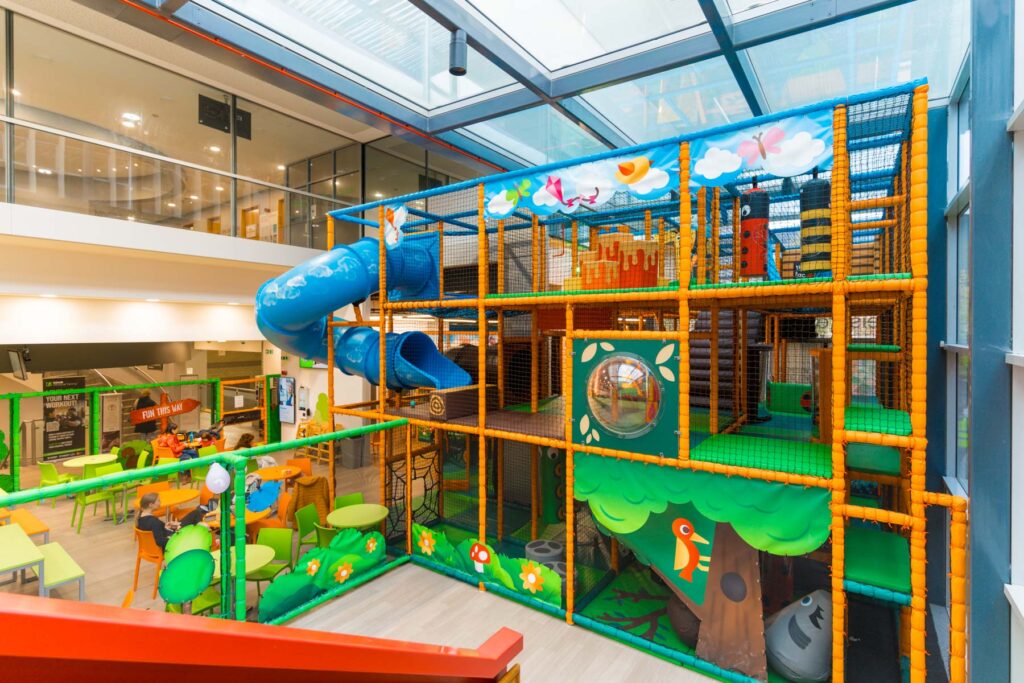
Want to see more than just above, we’ve got a page full of successful installations from a range of venues, all at differnet sizes, budgets and end goals.
Total annual maintenance and inspection cost for a well-run mid-size venue typically falls in the £4,000–£10,000 range. Venues that defer maintenance create significantly higher replacement costs, and significantly higher liability exposure.
Need some maintenance for your play space?
Fun fact, when The Play Company were initally established, it was soley a clening and maintenance company, serving the UK as a leading indoor cleaning service, now 20 years on, we’re able to deliver some of the best indoor play spaces across the world and service them at the same time.
If you need a quote or require a play cpace cleaned or maintained, we have the resources and crew to help.
How to choose a commercial indoor playground manufacturer
The quality of your indoor playground manufacturer determines not just the quality of the finished installation, but how smoothly the project runs, how quickly problems get resolved, and how long the equipment lasts. It is the single most consequential decision you will make.
End-to-end capability: design, manufacture, and installation managed by one business. This removes the risk of projects falling between disciplines and gives you a single accountable partner.
UK-based manufacturer: equipment manufactured in the UK means shorter lead times, easier quality control, and simpler warranty and repair logistics. It also means the manufacturer is subject to UK regulatory standards throughout production.
EN1176 compliance as standard: not as an option, not as an add-on. Ask for documentation and ask how compliance is verified during manufacture.
Case studies at comparable venues: Not just a portfolio, but evidence of projects at venues of similar scale, type, and operational context to yours. Ask for operator references.
Ongoing maintenance support: A manufacturer who disappears after installation is a risk. Confirm what post-installation support looks like, whether they offer maintenance contracts, and how reactive maintenance is handled.
Transparency at the quote stage: A credible commercial playground manufacturer will ask questions before quoting. A quote issued without understanding your venue, footprint, or visitor profile is not a quote — it’s a guess.
Download the Play Company Buyers' Guide
Everything you need to brief, procure, and install a commercial soft play environment — including a specification checklist, questions to ask your manufacturer, and a maintenance planning template.